Software engineer • AI automation • backend • cloud

I build AI systems that make operations faster, clearer, and safer.

I build production-facing systems across AI automation, backend APIs, cloud infrastructure, and delivery pipelines. The strongest recent work is private, so this portfolio turns the public signal into case studies, metrics, media, and a live personal dashboard.

The goal is simple: make it easy for recruiters, hiring managers, and engineers to see what I build, how I think, and where I am headed next.

AI automation Backend systems Cloud infrastructure CI/CD and operations Robotics trajectory

Resume-backed evidence

Real systems, real outcomes, and a trajectory that already makes sense.

60%

faster release time

Built 6+ CI/CD pipelines that shortened the path from change to deployment.

28%

lower infrastructure cost

Redesigned AWS environments across ECS, RDS, and S3 for healthier scaling.

5,000+

monthly active users supported

Scalable REST APIs and multi-tenant systems for chatbot and AI agent experiences.

100K+

users enabled for outreach

Compliant A2P 10DLC setup for production messaging operations.

35%

lower inference latency

Profiled and tuned CUDA-accelerated ML systems during internship work.

40%

less manual reporting

Automation flows that turned scattered operational updates into live signal.

Personal operating dashboard

A live-feeling command center for work, learning, health, and long-term direction.

The numbers are intentionally easy to replace later. For now they create a production-ready dashboard page that shows how I think about focus, energy, output, and professional trajectory.

Explore Dashboard
Work Output 86

+12 pts

Learning Velocity 78

+8 pts

Life Stability 72

+5 pts

Systems Health 83

+10 pts

Backend systems 88%
AI automation 91%
Cloud delivery 80%
Robotics bridge 67%

Public proof

TARS moved from private workflow to public explanation.

I added a short podcast clip here because it does something screenshots cannot: it shows I can explain the system, the guardrails, and the reasoning behind it in public.

Podcast feature

TARS on Teller's Tech

I joined Brian Teller on the Teller's Tech Ship It Conversations podcast to break down TARS, my n8n-based DevOps assistant for automating incident response work without removing human judgment where it matters.

  • Talked through how TARS connects into GitHub Actions, pipelines, SSH across multiple servers, diagnostics, and debugging context.
  • Explained how runbooks and repetitive incident-response steps can be translated into coded workflows that stay fast, adaptive, and useful.
  • Made the guardrails explicit: access to repos, servers, and infrastructure should be designed with caution first, not bolted on later.

This is useful proof because it shows the system can stand up in public explanation, not only in private implementation. It also gives the project a human voice beyond screenshots and metrics.

Host: Brian Teller Topic: DevOps, AI agents, incident response

Architecture evolution

FRIDAY was the first operational nerve. TARS became the guarded response layer.

This is the clearest product arc on the site right now: alerting first, then agent-guided action with stronger guardrails, better tooling context, and human approval where it should stay.

System evolution

FRIDAY became TARS by moving from visibility to guarded action.

FRIDAY started as a server-status bot that kept me ahead of downtime with fast notifications. TARS pushed the system further into incident response, human-in-the-loop decisions, and agent-assisted execution across my DevOps workflow.
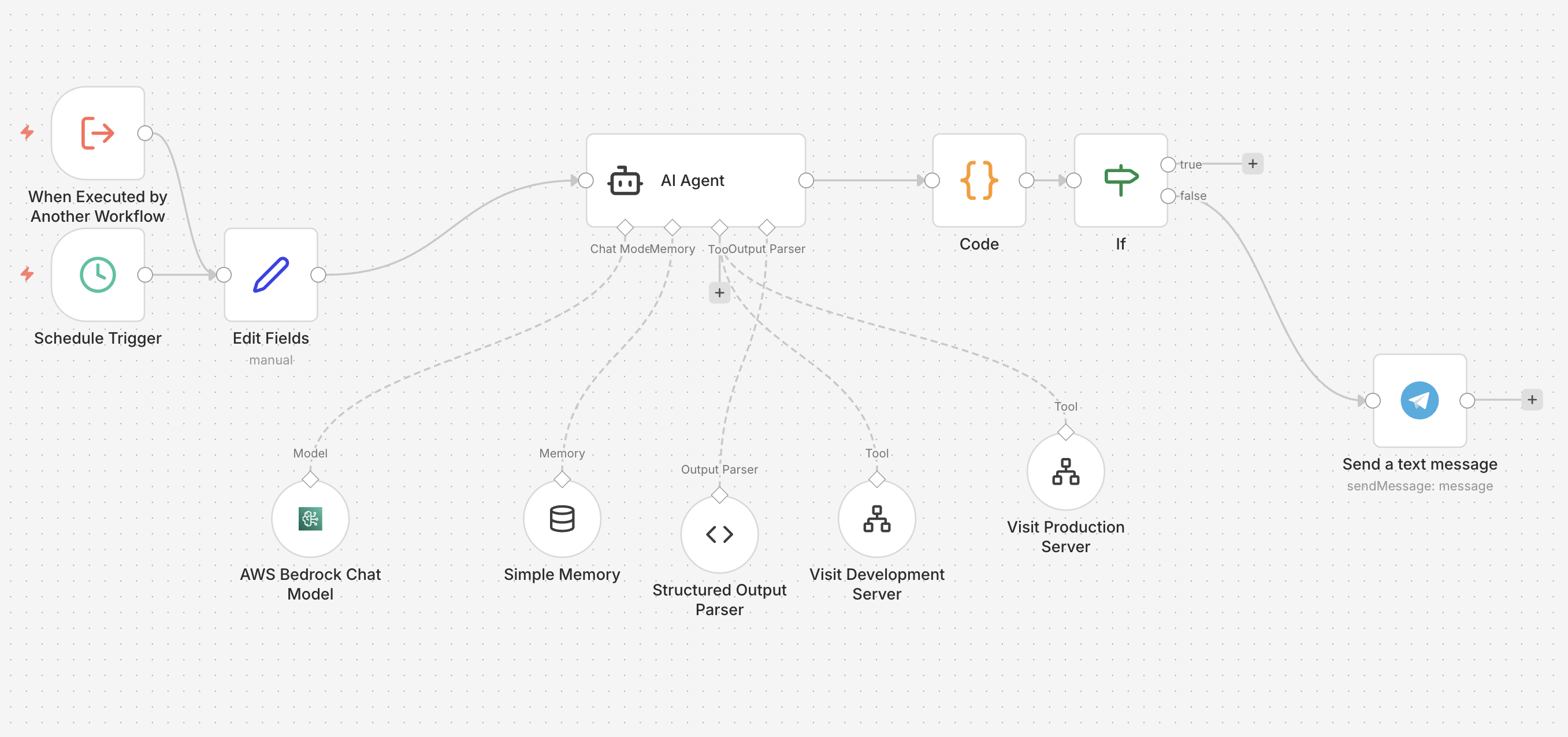
Phase 01 Monitoring-first assistant
FRIDAY n8n workflow screenshot

FRIDAY

A server-status bot that monitored uptime and downtime, then pushed alerts into channels like Telegram or Slack before QA or clients felt the issue.

The important move here was proactive visibility: less manual checking, faster awareness, and a stronger base for operational decision-making.
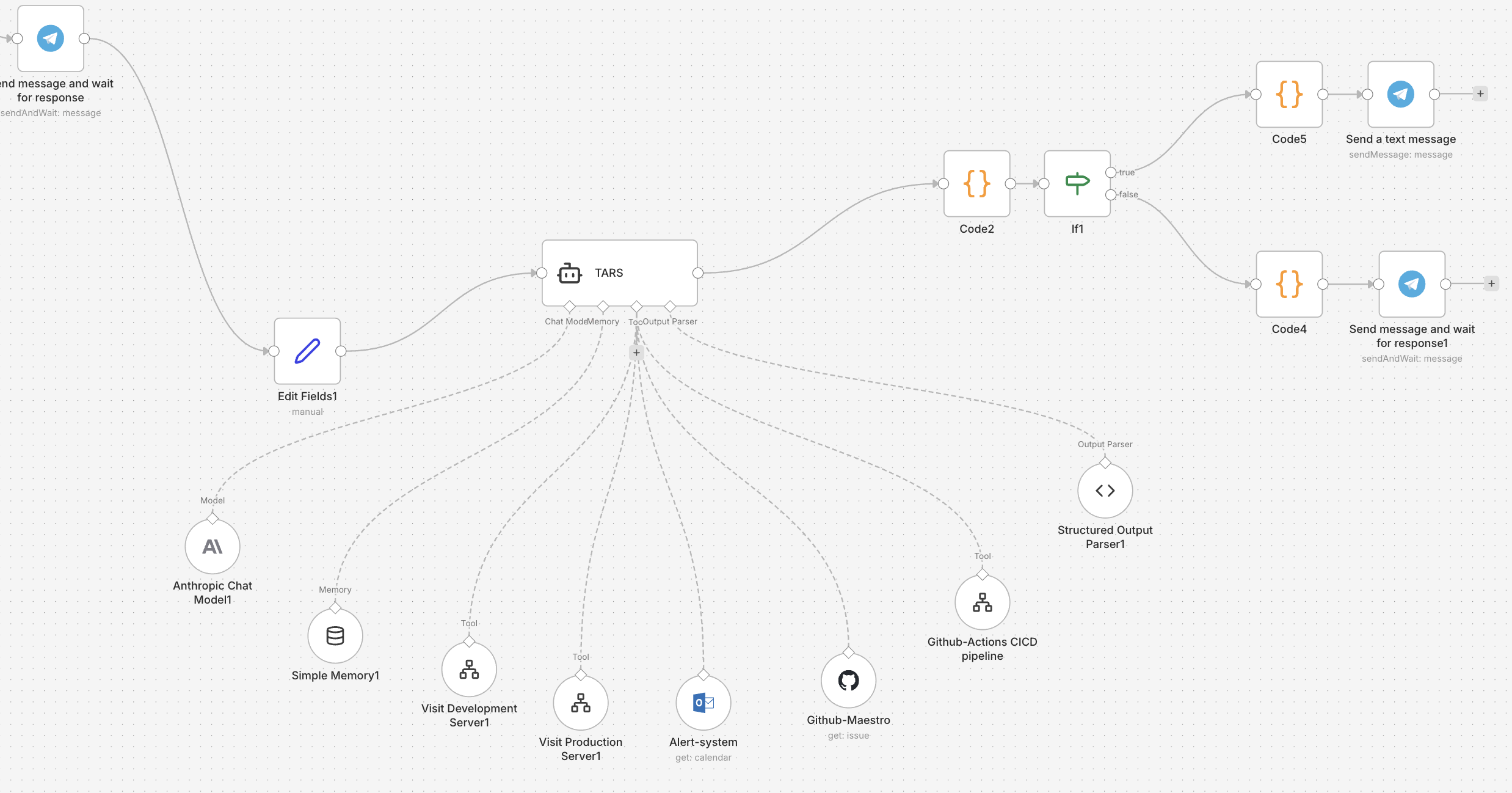
Phase 02 Human-guided DevOps agent
TARS n8n workflow screenshot

TARS

A more capable DevOps agent with GitHub Maestro, CI/CD pipeline visibility, alert-system context, server actions, and explicit human-in-the-loop checkpoints before major fixes.

The architectural shift was not just more automation. It was safer automation, split across focused agents so no single bot owns the whole system.

Featured case studies

Three projects that show how I think, what I build, and the environments I want to grow into.

Each case study is written to show constraints, decisions, and outcomes rather than just screenshots.

01

Automation / Observability

AI-Enhanced Operations Automation Suite

A TARS-style n8n DevOps assistant and workflow layer that turned incident-response steps, alerts, and operational noise into faster, safer action.

n8nGitHub ActionsSSH workflowsSlackTelegramMonday.comDiagnostics
  • 40% less manual reporting
  • Faster response loops
  • Guardrailed incident workflows
Read Case Study

02

Backend / Cloud / Delivery

Allyzent Product and Infrastructure Work

Production-facing API, cloud, delivery, and compliance work for AI-driven healthcare infrastructure.

PythonJavaScriptREST APIsAWSCI/CDSonarQubeTwilioLiveKit
  • 60% faster releases
  • 28% infra cost reduction
  • 5,000+ MAUs supported
Read Case Study

03

Infrastructure / Self-Directed Learning

Home Kubernetes Lab

A two-node Raspberry Pi k3s cluster built to learn infrastructure by operating it directly.

k3sRaspberry PiKubernetes manifestsSSHLinux networkingContainers
  • 2-node k3s cluster
  • Remote administration
  • Hands-on systems intuition
Read Case Study

Experience

Experience across production software, delivery systems, and self-directed infrastructure work.

The pattern across roles is consistent: reduce ambiguity, improve reliability, and ship systems that teams can actually operate.

Allyzent LLC

Software Developer, API & Security Specialist

June 2025 - Present Dallas, Texas / Remote
  • Built scalable REST APIs and microservices for AI agents and multi-tenant chatbot systems.
  • Delivered 6+ CI/CD pipelines and cut release time by 60%.
  • Reworked AWS environments to reduce infrastructure cost by 28%.
  • Supported 5,000+ monthly active users and compliant messaging workflows at scale.

Allyzent LLC

Product Manager, Healthcare Infrastructure & Automation

June 2025 - Present Dallas, Texas / Remote
  • Managed 4 cross-functional teams spanning engineering, design, and QA.
  • Led incident response and production issue resolution under launch pressure.
  • Used automation and tighter backlog systems to reduce feature delivery time by 22%.
  • Kept delivery, compliance, and product coordination moving on the same track.

Inspira Enterprise (Humans.ai project)

Machine Learning Intern

Jan 2024 - May 2024 Mumbai, India
  • Built a multi-agent LLM system around a large action model and JTBD workflow.
  • Improved inference latency by 35% through profiling, pipeline tuning, and CUDA acceleration.
  • Developed a real-time conversation analytics pipeline processing 10k+ daily interactions.

Upwork

Freelance Software Developer

May 2022 - June 2024 Remote
  • Built client-facing web products, browser automation tools, and C++ applications.
  • Used direct problem-framing and line-by-line questioning to clarify client needs.
  • Learned to earn trust by reducing confusion before writing code.

About

I like work that becomes more valuable when the constraints get real.

I do my best work where product pressure, delivery constraints, and infrastructure reality all meet. That usually means reducing ambiguity, tightening feedback loops, and making systems easier to operate.

My current focus is AI automation, backend services, CI/CD, and cloud systems. I am especially interested in roles where reliability, delivery quality, and technical judgment matter together.

Longer term, I am building toward robotics and autonomous systems by pairing graduate study with hands-on systems engineering work.

Education and direction

M.S. Robotics and Autonomous Systems

Arizona State University

Graduating May 2026

B.E. Computer Science, Honors in Cybersecurity

University of Mumbai

Completed May 2024

Capabilities

AI automation and workflow orchestrationBackend APIs and integrationsCloud systems and release engineeringAWS infrastructure and cost-aware scalingn8n workflows and operations toolingCUDA-adjacent performance workSystems thinking with product awarenessRobotics and autonomy trajectory

Future direction

Robotics is the long-term direction; systems work is the foundation.

  • Near term: keep deepening AI automation, backend systems, platform ownership, and production decision-making.
  • Bridge: connect systems engineering with perception, control, and real-world autonomy constraints through graduate work and hands-on projects.
  • Long term: build intelligent systems that operate reliably in the physical world, where software quality and engineering judgment both matter.